
Ballast System Wakesurf — Wakesurf Budapest
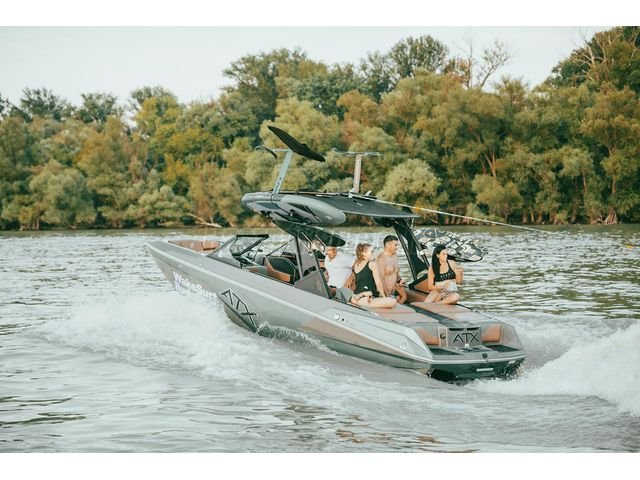
For ballast system wakesurf, Wakesurf Budapest offers the complete package on the Danube. In the ballast system wakesurf category we work with two premium wakesurf boats — Super Air Nautique G23 and ATX Type S 22 — at two locations (Wiking Yacht Club Marina and Budapest Yacht Club / Római-part), with professional instructors. Below we cover everything about ballast system wakesurf: boat specs (including the traditional and NSS™-controlled ballast systems), pricing tiers, and the booking process.
Ballast System Wakesurf can also be combined with other services on the same booking: motorboat rental with captain, sunset cruises across the Budapest panorama, or full-day Danube Bend tour towards Szentendre, Visegrád and Esztergom. Ballast System Wakesurf bookings have a 1-hour minimum, with per-minute billing afterwards — 4-hour weekday bookings get up to 20% discount.
What is the ballast system and why does it matter?
Wakesurf is the only sport where the boat is the most important piece of equipment. Modern wakesurf boats — including our Super Air Nautique G23 and ATX Type S 22 — generate large, surfable waves behind them via a so-called ballast system. ‘Ballast’ literally means weight — in this case extra water mass loaded into tanks inside the boat. More ballast = more weight = deeper draft = bigger wave.
How does a ballast system look in practice?
A modern wakesurf boat typically has 3-5 separate ballast tanks:
- Bow ballast — 200-400 kg of water in the bow
- Middle ballast — 300-600 kg of water in the middle
- Stern ballast left and right — 200-500 kg of water on each side, allowing the wave to be steered to either side
- Plumper / extra ballast bag — additional, movable ballast bag, sat on by guests or fixed in place. Pro level can add 200-400 kg.
On modern boats (like the G23) all of these can be filled and emptied with a single switch from the helm — ballast character changes in seconds.
Ballast vs. wave character — the technical explanation
The amount and distribution of ballast determines three things:
- Wave height — more water = deeper draft = higher wave. Beginner-friendly waves are 0.6-0.8 m, pro competition waves 1.0-1.4 m.
- Wave length and ‘pocket’ — the ratio of middle to stern ballast determines whether the wave is short and steep (trick-friendly, advanced) or long and rolling (beginner-friendly).
- Wave side — left or right surf wave. The left-right stern ballast ratio controls this: if the left tank is full, the wave forms on the left side.
Factory ballast vs. extra ballast bag
Wakesurf has two main ballast solutions:
Factory ballast tanks
Built-in, fixed tanks. The boat fills and empties them automatically with a pump system. Pros: fast, automatic, safe. Cons: limited capacity (1000-1400 kg).
Extra ballast bag
Movable, water-fillable bag. Flexibly placed anywhere inside the boat. Pros: extra weight +200-400 kg, where and when needed. Cons: manual labor, takes space.
For pro-level waves we usually combine both solutions: factory ballast provides the stable base, extra ballast bags fine-tune the wave character.
How much ballast is ideal?
| Goal | Ballast (kg) | Wave character |
|---|---|---|
| Beginner, child | 600-900 kg | Low, long, rolling |
| Intermediate | 900-1200 kg | Medium, balanced |
| Pro / competition | 1200-1700 kg | Tall, steep, trick-friendly |
Why is ballast important in wakesurf lessons?
The first step in any wakesurf lesson is the instructor matching the boat’s ballast system to the guest’s level. For an 8-year-old child a small, soft wave is needed (600-700 kg ballast); for a 30-40 year old adult riding for the first time, a medium wave (900-1100 kg); for an advanced returner, a competition-grade wave (1300+ kg).
We offer the full ballast spectrum on both our boats: the Super Air Nautique G23 has the cockpit-controlled NSS™ system, the ATX Type S 22 uses traditional adjustable ballast tanks plus extra ballast bags.
Our ballast boats — quick comparison ballast system wakesurf
Super Air Nautique G23
- 1380+ kg factory Hydrogate ballast
- NSS™ Surf System (cockpit-controlled)
- Extendable with extra ballast bags
- Pro competition wave possible
ATX Type S 22
- Classic adjustable ballast system
- Manual fill control
- Extendable with extra ballast bags
- Club-friendly, sport-grade wave
Wakesurf experience on the Danube — all our services in one place
Wakesurf Budapest is the complete wakesurf, motorboat rental and sunset cruise provider in the city. We work with two premium wakesurf boats on the Danube: models built by Super Air Nautique and ATX Boats. Both boats run a traditional or NSS™-controlled ballast system, so the wakesurf wave character can be fine-tuned in minutes — from beginner-friendly to competition-grade steep waves.
Our motorboat rental with captain option means you can come home with more than just a wakesurf experience: sunset cruises, city sightseeing on the Danube, Danube Bend tour (Szentendre, Visegrád, Esztergom) are also available on the same boats. For group events (bachelor parties, corporate days, birthdays, family programs) we especially recommend the private booking system — 4-hour weekday booking gives up to 20% discount.
Related services
- Wakesurf lessons for beginners and advanced riders
- Motorboat rental with captain
- Sunset cruise and Danube Bend tour
- Prices and online booking
Why choose us for ballast system wakesurf
We have been building our ballast system wakesurf service on the Danube for 8 years, refining it continuously based on returning guests’ and club members’ feedback. For ballast system wakesurf, Wakesurf Budapest brings two premium American boats (NSS™ + classic ballast wakesurf systems), two locations (Wiking Yacht Club Marina + Budapest Yacht Club), professional instructors, optional motorboat rental with captain and sunset cruise add-ons — combinable on the same booking. Book your slot online →