
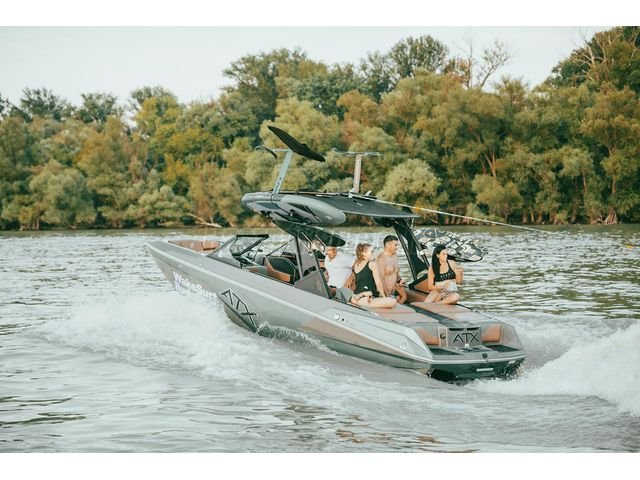
What is the ballast system and why does it matter?
Wakesurf is the only sport where the boat is the most important piece of equipment. Modern wakesurf boats — including our Super Air Nautique G23 and ATX Type S 22 — generate large, surfable waves behind them via a so-called ballast system. ‘Ballast’ literally means weight — in this case extra water mass loaded into tanks inside the boat. More ballast = more weight = deeper draft = bigger wave.
How does a ballast system look in practice?
A modern wakesurf boat typically has 3-5 separate ballast tanks:
- Bow ballast — 200-400 kg of water in the bow
- Middle ballast — 300-600 kg of water in the middle
- Stern ballast left and right — 200-500 kg of water on each side, allowing the wave to be steered to either side
- Plumper / extra ballast bag — additional, movable ballast bag, sat on by guests or fixed in place. Pro level can add 200-400 kg.
On modern boats (like the G23) all of these can be filled and emptied with a single switch from the helm — ballast character changes in seconds.
Ballast vs. wave character — the technical explanation
The amount and distribution of ballast determines three things:
- Wave height — more water = deeper draft = higher wave. Beginner-friendly waves are 0.6-0.8 m, pro competition waves 1.0-1.4 m.
- Wave length and ‘pocket’ — the ratio of middle to stern ballast determines whether the wave is short and steep (trick-friendly, advanced) or long and rolling (beginner-friendly).
- Wave side — left or right surf wave. The left-right stern ballast ratio controls this: if the left tank is full, the wave forms on the left side.
Factory ballast vs. extra ballast bag
Wakesurf has two main ballast solutions:
Factory ballast tanks
Built-in, fixed tanks. The boat fills and empties them automatically with a pump system. Pros: fast, automatic, safe. Cons: limited capacity (1000-1400 kg).
Extra ballast bag
Movable, water-fillable bag. Flexibly placed anywhere inside the boat. Pros: extra weight +200-400 kg, where and when needed. Cons: manual labor, takes space.
For pro-level waves we usually combine both solutions: factory ballast provides the stable base, extra ballast bags fine-tune the wave character.
How much ballast is ideal?
| Goal | Ballast (kg) | Wave character |
|---|---|---|
| Beginner, child | 600-900 kg | Low, long, rolling |
| Intermediate | 900-1200 kg | Medium, balanced |
| Pro / competition | 1200-1700 kg | Tall, steep, trick-friendly |
Why is ballast important in wakesurf lessons?
The first step in any wakesurf lesson is the instructor matching the boat’s ballast system to the guest’s level. For an 8-year-old child a small, soft wave is needed (600-700 kg ballast); for a 30-40 year old adult riding for the first time, a medium wave (900-1100 kg); for an advanced returner, a competition-grade wave (1300+ kg).
We offer the full ballast spectrum on both our boats: the Super Air Nautique G23 has the cockpit-controlled NSS™ system, the ATX Type S 22 uses traditional adjustable ballast tanks plus extra ballast bags.
Our ballast boats — quick comparison
Super Air Nautique G23
- 1380+ kg factory Hydrogate ballast
- NSS™ Surf System (cockpit-controlled)
- Extendable with extra ballast bags
- Pro competition wave possible
ATX Type S 22
- Classic adjustable ballast system
- Manual fill control
- Extendable with extra ballast bags
- Club-friendly, sport-grade wave